
Intro
One of the most important things we try to ensure clients understand is that materials account for much more than just the visual character of a piece. Quality and longevity are the natural result of using the right material for the project at hand. Whether it’s the rich warmth and workability of natural wood or the structured reliability of MDF and metals, each material brings with it unique virtues, challenges, and outcomes. Choose what you like best: fabrication from natural wood, metals, MDF, acrylic…
At Mixed Bag Solutions Inc., we work with just about every variety of material you can think of when we tackle our residential and commercial projects. Over the years, we’ve learned a lot about how these materials change over time, and how wear and tear and environmental exposure ultimately affect them decades down the road. Here is what we think every homeowner, designer, or builder should understand when choosing and working with these popular materials:
Fabrication from natural wood
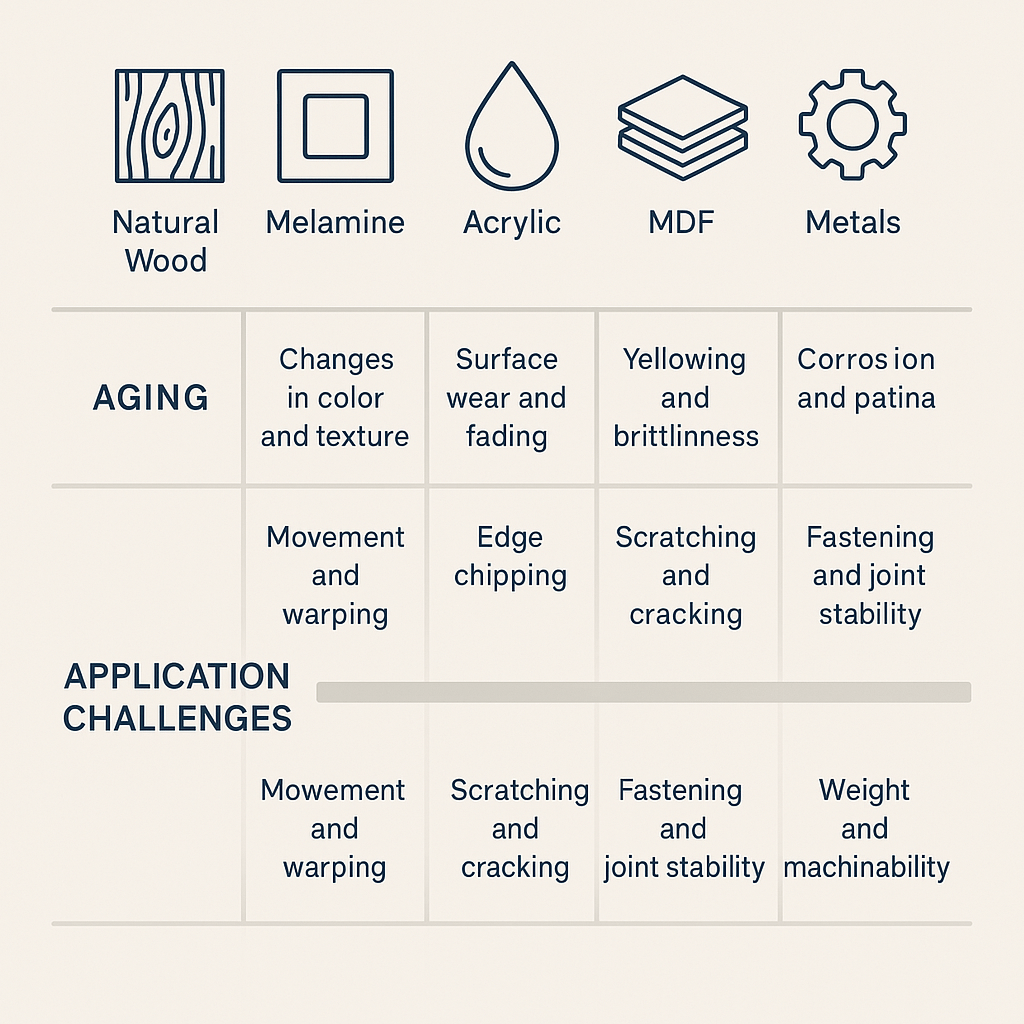
Real wood is still the gold standard. Oak, maple, walnut and pine are timeless! While these materials boast a “living” quality, their organic nature means they will continue to evolve after installation
Wood tends to expand and contract with humidity, as one would expect from a porous material, which can lead to warping and cupping. Luckily, we can account for this in the design process!
Natural wood also tends to darken over time. Much like our own skin, this is because of oxidation and UV exposure. Of course, this isn’t necessarily a bad thing: some types of wood develop a richer patina, though others may become slightly uneven in colour.
Always allow wood to acclimate to its environment before installation. And in fabrication from natural wood use protective finishes, and avoid placing wood in direct sunlight or sources of high humidity.
Melamine
While melamine can mimic wood’s appearance, it’s a synthetic resin most often used with particleboard or MDF. Melamine is highly resistant to staining and scratching, making it one of our favourite materials to work with when we’re building cabinetry, furniture, and shelving.
You can think of Melamine almost like a variety of plastic. Because of this, it sports a very consistent and uniform appearance and resists moisture much better than wood. However, you must still protect the particleboard or MDF components from moisture!
Acrylic
If you’ve done any sort of crafting or hobby in your personal life, you’re likely already familiar with Acrylic. In a construction context, Acrylic is commonly employed to add a glossy, glassy surface to wall panels and cabinetry.
Though unquestionably beautiful, Acrylic demands to be treated with care. Low-grade Acrylic can yellow over time if not treated with a UV stabilizer. This material is also sensitive to scratches and heat, so factor gaps into the installation process to account for expansion.
MDF (Medium-Density Fiberboard)
If you’re in the industry, you know about MDF. It’s one of the most common and widely used wood products, and you’ve probably walked by tons of it on your last trip to the hardware store. This engineered wood, made from wood fibre, is an all-star for millwork and cabinetry and offers a smooth surface that lends itself well to painting and veneering
Eminently affordable and pleasingly uniform, MDF is a great choice for home projects. However, no material is perfect. Like all wood products, water can cause MDF to swell, and the edges of MDF pieces should be sealed or banded to protect them from damage.
Metals
Metals are cool to the touch, and even cooler to work with. Aluminum, brass, and steel add a bit of edge and a feeling of modernity to your indoor and outdoor spaces. IIn the hands of a creative designer, metal offers incredible versatility: it can take starring roles as panelling or millwork, or work behind the scenes as structural support.
Try to limit your metal’s exposure to moisture and salt, which can cause corrosion faster than you might think. While metal can be protected in different ways (brushed, polished, or powder-coated), each will cause the metal to age differently and develop a unique patina.
Making a Mosaic
Each of these diverse materials brings something unique to a project. In our view, they are even better together than they are alone! However, combining these materials presents challenges that extend beyond aesthetics and require careful consideration during planning.
- Wood and metal expand and contract at significantly different rates. If joined together lazily, without adequate “wiggle room”, this often leads to cracking or sometimes full-on detachment.
- Wood, MDF, and metal all dislike moisture, so deploying these materials together in wet environments demands robust waterproofing and sealing.
Lastly, we have to consider the finish. Some surfaces (like wood) appreciate regular maintenance and touch-ups, while something like Melamine ages uniquely. It’s important to create a maintenance plan that considers these unique qualities before installation.
Final Thoughts
When choosing a material to work with, we always recommend that clients think less about immediate appeal and more about the long-term. Each material has a unique lifecycle, and greater awareness of its characteristics empowers clients to make informed choices that deliver on their vision while maximizing the longevity of a renovation or addition.
We love talking materials. You can reach out to our team any time for personalized design advice and educated recommendations for your next project. At Mixed Bag Solutions Inc. you can order fabrication from natural wood, metals, MDF, acrylic.